How to secure AI in regulated firms


A Practical, Tactical Guide for Operations, IT and Compliance Leaders
Executive Overview
AI is one of the most talked-about topics in business and cybersecurity today. In our experience, guidance on how to protect against AI-related risks has consistently been among the most read and discussed topics with regulated firms.
But AI is not a single tool or a fixed technology. It is broad, rapidly evolving and increasingly embedded in the tools you use and trust daily, such as Microsoft 365, SaaS platforms, supplier ecosystems and everyday employee workflows. At the same time, attackers are using AI to increase the speed, precision and scale of phishing, impersonation and intrusion techniques.
This creates a practical challenge for Operations, IT and Compliance leaders: how do you build control around something that is constantly changing?
The answer is not to chase every new tool or headline risk. It is to build an adaptable framework that can absorb change. It should focus on visibility, governance, monitoring and validation rather than reacting to individual AI features.
For regulated mid-sized firms, the objective is not to build an enterprise AI programme. It is to create structured, demonstrable control that can evolve as AI evolves.
Part 1: How AI Is Changing Your Risk Exposure
AI does not introduce an entirely new category of cyber risk. It amplifies the risks you already manage. It increases their speed, expands their reach and makes them harder to detect. Understanding that amplification is the first step to controlling it.
1A. AI-Driven Attacks Are More Sophisticated
Attackers are now using AI to improve what they were already doing. Phishing emails are better written and more context-aware. Impersonation attempts are more convincing. Reconnaissance on executives and key staff can be automated. Known weaknesses can be identified and exploited more quickly. For Operations and IT leaders, this means traditional red flags are weaker. Staff are more easily manipulated. Credential theft attempts blend in more effectively with normal business communication. Attack campaigns scale rapidly and can target multiple individuals simultaneously. AI does not change the type of attacks you face. It changes their volume, credibility and speed.
1B. Employees Are Using AI Tools Every Day
AI usage is now embedded across departments, from legal drafting and financial modelling to HR communications, client reporting, marketing content and code generation. This creates two distinct exposure paths.
Shadow AI
Shadow AI refers to unapproved or unmonitored use of generative AI tools. Employees may paste sensitive information into public AI platforms, upload contracts for summarisation, or experiment with tools that have not been reviewed by IT or Compliance. The intent is usually productivity, not misuse. However, the operational risk is significant. Sensitive data can leave your controlled environment. There may be no audit trail. Data retention and reuse terms may be unclear. When a regulator or client asks how AI is controlled, you may not have a confident answer. The core issue is not malicious behaviour. It is invisibility.
Approved AI Tools
Even when AI tools are formally approved (such as Microsoft Copilot or AI-enabled SaaS features) exposure does not disappear. These tools typically inherit user permissions. If access controls are broad, AI inherits that breadth. Data indexing may exceed expectations. Logging may not be configured or retained long enough to support investigation or audit. Configuration drift may go unnoticed as environments change. Approved does not mean risk-free. AI amplifies whatever access it is given.
1C. Third-Party and Supplier AI Exposure
AI exposure is not confined to your internal systems. Suppliers may use AI to process your data, embed AI features into their platforms, or automate decisions that affect your operations. In regulated environments, accountability does not transfer with the processing. This creates compliance risk. Data may be processed by AI systems outside your visibility. Contractual terms may not clearly define how AI is used. Assurance may be based on high-level statements rather than evidence. Indirect exposure is still your responsibility.
Why AI Risk Feels More Challenging
AI risk intersects with two realities that mid-sized regulated firms already face.
First, operational complexity. Teams are lean. Cloud, SaaS and identity environments change constantly. AI introduces another moving layer without replacing any existing obligation.
Second, regulatory and client pressure. FCA scrutiny, operational resilience requirements, GDPR obligations and increasingly detailed client questionnaires all demand demonstrable control. It is not enough to say that AI is “being looked at.” You must evidence governance, monitoring and response capability.
The challenge is not only securing AI. It is demonstrating control over AI-driven exposure.
Part 2: A Practical Control Framework
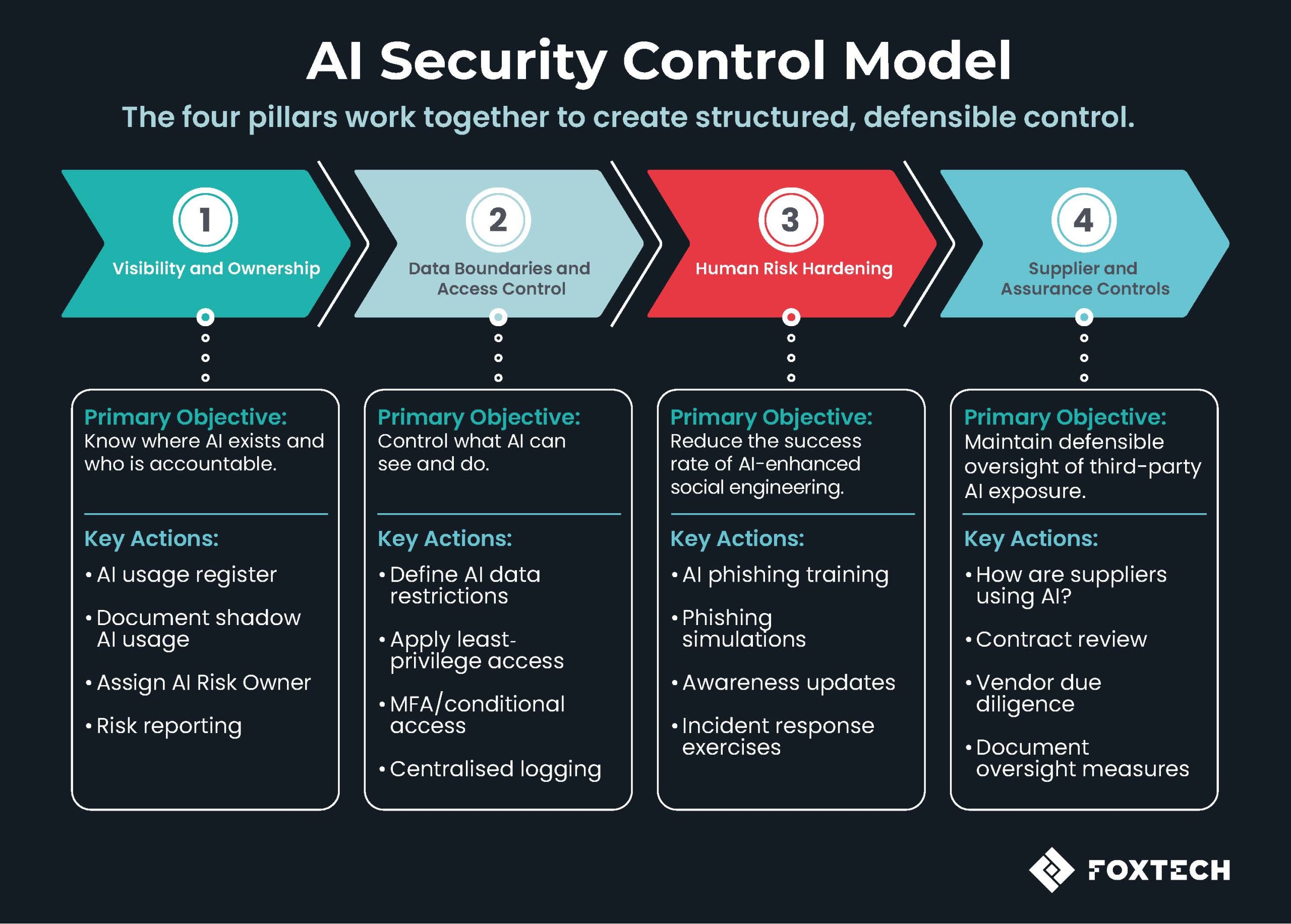
Rather than treating each AI risk separately, regulated firms should focus on four reinforcing control pillars.
Each pillar addresses specific exposure areas identified in Part 1 and can be implemented progressively.
The Four Control Pillars
PILLAR 1: Visibility and Ownership
Primary Objective: Know where AI exists and who is accountable. Key Actions:
- Create and maintain an AI usage register (approved tools, pilots, supplier AI exposure)
- Identify and document shadow AI usage
- Assign a named AI risk owner (CIO, CISO or Risk Lead)
- Include AI in the corporate risk register and reporting cycle
Addresses:
- Shadow AI invisibility
- Governance gaps
- Board-level accountability risk
- Regulatory defensibility concerns
PILLAR 2: Data Boundaries and Access Control
Primary Objective: Control what AI can see and do. Key Actions:
- Define what data must never be entered into AI tools
- Apply least-privilege access to AI-enabled systems
- Enforce phishing-resistant MFA and conditional access
- Enable centralised logging and retain logs (e.g. 12 months for regulated environments)
Addresses:
- Data leakage via AI tools
- Over-permissioned Copilot / SaaS AI features
- AI-amplified credential theft
- Audit and investigation readiness
PILLAR 3: Human Risk Hardening
Primary Objective: Reduce the success rate of AI-enhanced social engineering. Key Actions:
- Update awareness training to include AI-driven phishing and impersonation
- Run targeted phishing simulations
- Brief executives on deepfake and fraud risk
- Include AI-related scenarios in incident response exercises
Addresses:
- AI-enhanced phishing
- Impersonation and deepfake fraud
- Credential compromise risk
PILLAR 4: Supplier and Assurance Controls
Primary Objective: Maintain defensible oversight of third-party AI exposure. Key Actions:
- Ask suppliers how AI is used on your data
- Review contractual data processing and retention terms
- Include AI in vendor due diligence and risk assessments
- Document oversight for regulatory and client assurance
Addresses:
- Indirect AI exposure
- Supply chain risk
- Regulatory and client scrutiny
90-Day Implementation Plan
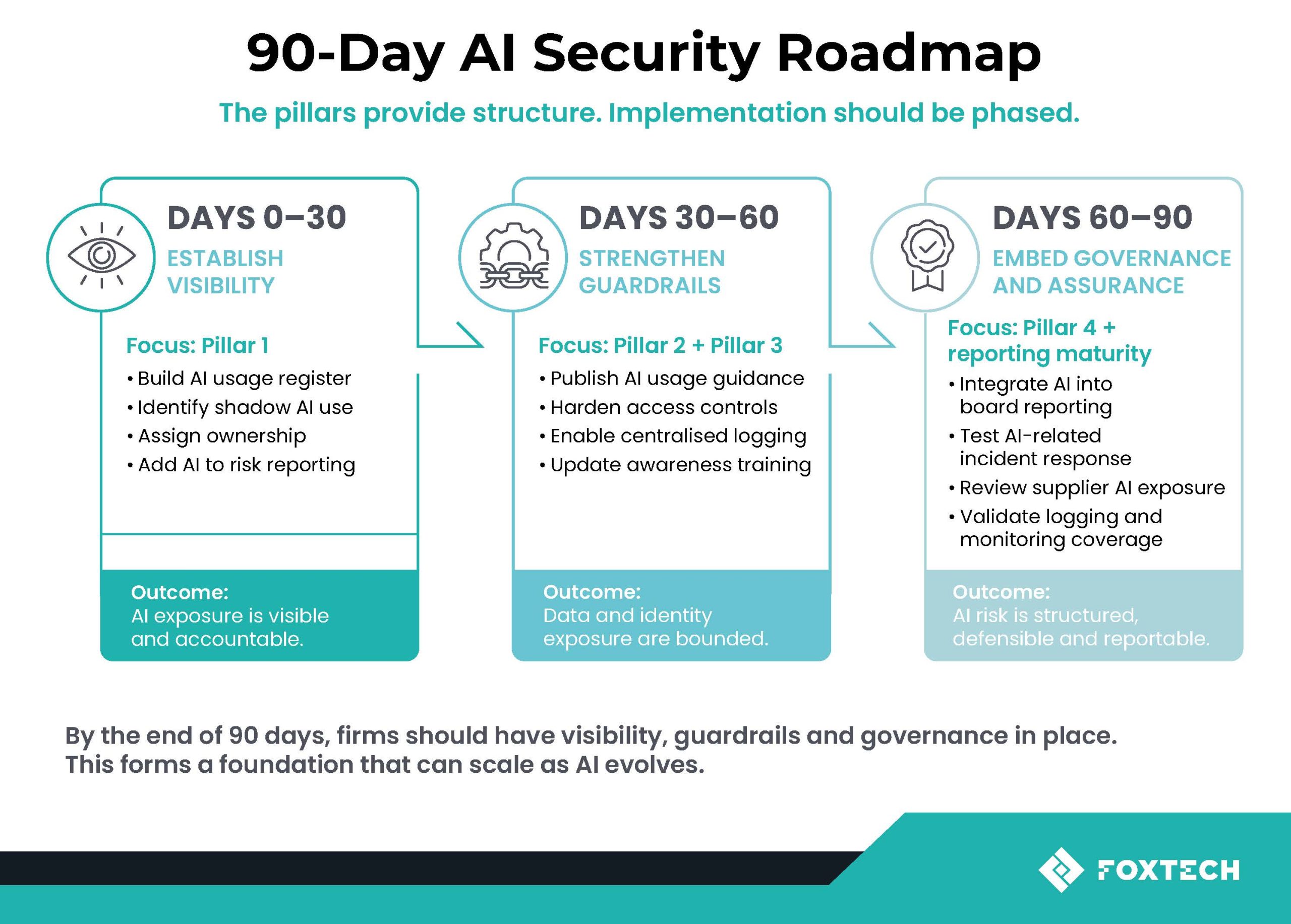
The pillars provide structure. Implementation should be phased.
Days 0–30: Establish Visibility
Focus: Pillar 1
- Build AI usage register
- Identify shadow AI use
- Assign ownership
- Add AI to risk reporting
Outcome: AI exposure is visible and accountable.
Days 30–60: Strengthen Guardrails
Focus: Pillar 2 + Pillar 3
- Publish AI usage guidance
- Harden MFA and access controls
- Enable centralised logging
- Update awareness training
Outcome: Data and identity exposure are bounded.
Days 60–90: Embed Governance and Assurance
Focus: Pillar 4 + reporting maturity
- Integrate AI into board reporting
- Test AI-related incident response
- Review supplier AI exposure
- Validate logging and monitoring coverage
Outcome: AI risk is structured, defensible and reportable. By the end of 90 days, firms should have visibility, guardrails and governance in place. This forms a foundation that can scale as AI evolves.
Part 3: How FoxTech Can Help
The framework in Part 2 is straightforward. Implementing it consistently in a fast-moving, AI-driven threat environment is the harder part. FoxTech helps regulated mid-sized firms operationalise the pillars through three practical capabilities.
Continuous Monitoring of Emerging Exposure
AI-driven threats evolve quickly. Exposure changes through configuration drift, new SaaS features and identity misuse. We help firms establish:
- Centralised logging across cloud, endpoint, email and identity
- Real-time monitoring of suspicious behaviour
- Automated detection of new external exposure
- Retained logs (e.g. 12 months) for investigation and regulatory defensibility
The outcome: you can confidently say, “Yes, we would see that.”
Continuous Validation of Controls
Controls must be tested regularly, not annually. We support:
- Ongoing real-world testing across infrastructure, cloud and applications
- Validation of identity and access controls
- Rapid retesting after remediation or significant change
The outcome: blind spots are identified before they are exploited.
Operational Enforcement and Board-Ready Reporting
Governance only works when technically enforced and clearly reported. We help firms:
- Harden identity and cloud configurations
- Ensure logging and monitoring are properly configured and retained
- Feed findings directly into remediation workflows
- Produce reporting that translates technical exposure into business risk
The outcome: AI risk is visible, controlled and defensible.

Wondering how this applies to your business?
Talk it through with a senior specialist.
20 to 30 minutes, no prep, no pitch.
